A while back, I bought a domain, because I thought it would be cool to have a domain, and also because I thought the domain name was clever: http://www.supervillaino.us/
I didn't have any plans for it, but I figured, why not? It was only ten bucks a year.
Then I recently noticed that Blogger will allow you to set up a blog on a domain of your choice for free! I figured, hey, I use Blogger, and I have a domain, so why not? I set up a new blog with Blogger and put it on my domain.
Those of you who are familiar with Blogger may be wondering why I didn't just change this existing blog to use the new URL. I have two answers to that:
1. This way, I can keep using both blogs. So far, Lord Admiral has been a weird mix of personal notes that are only of interest to my friends and family, and reviews that are meant for a larger audience (though probably still only read by my friends and family). Going forward, I will use Lord Admiral for the personal stuff, and post the more general (and more interesting) stuff on Supervillainous.
2. I didn't notice that I could have kept this blog until it was too late.
I also took this opportunity to change my Google screen name from Lord Admiral to Baron von Chop. I was never happy with Lord Admiral, because for one thing it sounds far too high-fallutin', and for another, it's not really a name, just a rank. Baron von Chop may include a rank, but somehow I don't think that anyone will get the impression that I'm full of myself from a name like that.
Thursday, October 28, 2010

Tuesday, October 26, 2010
Mike Mignola Writes and Draws Hellboy Again
About time I posted the link to the new Mignola-written, Mignola-illustrated Hellboy story, The Whittier Legacy.
I'll leave this entry short so that you don't waste time reading it, but go read Hellboy instead!
I'll leave this entry short so that you don't waste time reading it, but go read Hellboy instead!
Friday, October 22, 2010
The DIY Dragon
Over the past weekend, my dear lady and I flew down to LA to attend the wedding of two very cool people. The bride looked lovely, the groom was dapper, the ceremony was heartfelt and the banquet afterward was staggering, including an estimated 11 courses of awesome Chinese food and a truly epic cake.
It was my first time in LA, so I also got to see some of the landmarks and tourist spots, such as the Hollywood sign, the Walk of Fame and Mann's Chinese Theater.
To celebrate the happy couple, I thought I'd write them a silly little story. Here goes.
The DIY Dragon
For the Eyeball Burpers
In a far-off kingdom there lived a kindly king and queen. They had a single daughter, the apple of their eye. As she grew older, all of the young men of the realm began to compete for her attention, and foremost among them was the king's youngest and bravest knight.
To prove his love, the knight sorted out a misunderstanding surrounding a black knight and a bridge, and he helped some farmers with an incursion of manticores. He was pretty badass.
The princess, meanwhile, sewed a tapestry. The subject of the tapestry was ogre wrestling, so the princess went out and wrestled the biggest ogres in the kingdom as research for her tapestry. When she ran out of ogres, she chopped up some gorgons, for the design on the tapestry's border. She was pretty badass, too.
The king looked with favor on the knight, knowing that the young man was a match for his formidable daughter. The king was something of a traditionalist, however, and he waited for a dragon to swing by and kidnap his daughter, so that he could offer her hand in marriage to whoever saved her. The king was sure the knight was more than up to the task, and he wasn't the slightest bit worried about his daughter, who could handle any dragon.
The knight and princess waited patiently. The princess even resolved to avoid suplexing the dragon before the knight arrived so that he could rescue her the old-fashioned way (though she reserved the right to soften the dragon up a bit). There was only one problem: no dragon appeared.
The king and his councilors were puzzled. The latest survey of the dragon population indicated that there were plenty of dragons about. What they had not realized was that the dragons had gotten wise to the situation and learned to steer clear of the knight, and no dragon in the kingdom was foolish enough to try to kidnap such a princess.
The lamentable lack of draconic abduction may have caused another couple to despair, but these two were undaunted. They found the royal engineer with the wispiest beard and the most cluttered workplace, and they commissioned a mighty work to their specifications. The knight visited a scheming alchemist with chemical-stained fingers, while the princess sought out an experienced ranger with eyes like a hawk. When these two creative souls set their minds to a task, nothing could stop them, and there was nothing they loved more than working on a project together.
 On Saturday, October 16, the royal court was in an uproar. Courtiers ran hither and thither while ladies gossiped and men shouted. A great crowd gathered in the courtyard, and all faces looked up to the princess's tower, where a great wood-and-paper dragon beat its enormous wings slowly as it perched on the balcony. The dragon's eyes glowed red with the heat of its furnace as smoke poured from its smokestack nostrils.
The knight sad astride the clattering, puffing beast. He worked a complex control panel full of levers and knobs and beamed at his princess as she emerged from her room. She somersaulted into the empty chair next to the knight's and cranked a steering wheel, sending the dragon flapping mightily from the tower.
The beast roared and spat flame into the air as it flew over the courtyard, so low that the onlookers tumbled to the ground in surprise and delight. The dragon sped off, carrying the princess and the knight to their next adventure.
The king watched them go with a smile on his face. "Works for me," he said, and dabbed at his eye with a handkerchief.
It was my first time in LA, so I also got to see some of the landmarks and tourist spots, such as the Hollywood sign, the Walk of Fame and Mann's Chinese Theater.
To celebrate the happy couple, I thought I'd write them a silly little story. Here goes.
The DIY Dragon
For the Eyeball Burpers
In a far-off kingdom there lived a kindly king and queen. They had a single daughter, the apple of their eye. As she grew older, all of the young men of the realm began to compete for her attention, and foremost among them was the king's youngest and bravest knight.
To prove his love, the knight sorted out a misunderstanding surrounding a black knight and a bridge, and he helped some farmers with an incursion of manticores. He was pretty badass.
The princess, meanwhile, sewed a tapestry. The subject of the tapestry was ogre wrestling, so the princess went out and wrestled the biggest ogres in the kingdom as research for her tapestry. When she ran out of ogres, she chopped up some gorgons, for the design on the tapestry's border. She was pretty badass, too.
The king looked with favor on the knight, knowing that the young man was a match for his formidable daughter. The king was something of a traditionalist, however, and he waited for a dragon to swing by and kidnap his daughter, so that he could offer her hand in marriage to whoever saved her. The king was sure the knight was more than up to the task, and he wasn't the slightest bit worried about his daughter, who could handle any dragon.
The knight and princess waited patiently. The princess even resolved to avoid suplexing the dragon before the knight arrived so that he could rescue her the old-fashioned way (though she reserved the right to soften the dragon up a bit). There was only one problem: no dragon appeared.
The king and his councilors were puzzled. The latest survey of the dragon population indicated that there were plenty of dragons about. What they had not realized was that the dragons had gotten wise to the situation and learned to steer clear of the knight, and no dragon in the kingdom was foolish enough to try to kidnap such a princess.
The lamentable lack of draconic abduction may have caused another couple to despair, but these two were undaunted. They found the royal engineer with the wispiest beard and the most cluttered workplace, and they commissioned a mighty work to their specifications. The knight visited a scheming alchemist with chemical-stained fingers, while the princess sought out an experienced ranger with eyes like a hawk. When these two creative souls set their minds to a task, nothing could stop them, and there was nothing they loved more than working on a project together.
 On Saturday, October 16, the royal court was in an uproar. Courtiers ran hither and thither while ladies gossiped and men shouted. A great crowd gathered in the courtyard, and all faces looked up to the princess's tower, where a great wood-and-paper dragon beat its enormous wings slowly as it perched on the balcony. The dragon's eyes glowed red with the heat of its furnace as smoke poured from its smokestack nostrils.
The knight sad astride the clattering, puffing beast. He worked a complex control panel full of levers and knobs and beamed at his princess as she emerged from her room. She somersaulted into the empty chair next to the knight's and cranked a steering wheel, sending the dragon flapping mightily from the tower.
The beast roared and spat flame into the air as it flew over the courtyard, so low that the onlookers tumbled to the ground in surprise and delight. The dragon sped off, carrying the princess and the knight to their next adventure.
The king watched them go with a smile on his face. "Works for me," he said, and dabbed at his eye with a handkerchief.
Saturday, October 9, 2010
Computer Game Review Supplement: Mass Effect Combat Supplement
Since my Mass Effect review was such a success (cricket cricket), I decided to post some more thoughts on the game. I'd like to talk some more about the combat system, because even though it's not the best thing about the game (the characters, story, and setting are what really make this game shine), it's still really fun, but it has some down sides you may want to know about before deciding about whether or not you'd like to play.

Combat will feel very familiar to gamers. You can hold the spacebar to pause the game and open up the squad command/special attack screen, above, which allows you to change weapons, change the squad AI's behavior, or use special attacks.
You will always have two squad members on your team. No more, no less. You can pick them at the start of each mission, or whenever you leave the Normandy.
Healing is very simple: press F to use a health pack. It will heal you and your squad. How much each health pack heals and how often you can use one depends on your squad's total First Aid skill.
You also have grenades, which you throw with R and detonate with another press of R. These can be very useful in certain situations and all but useless in others.
Combat is cover-based, meaning your character will hide behind cover if you walk up against it. You can pop up from behind cover by clicking the aim button (right clicking), which is very easy to get used to. Unfortunately, cover does not protect you from explosive attacks.
Mass Effect features very cool-looking bad guys rendered very well, but for all that, most of the time you're going to be shooting at the aiming reticles on your screen. These are drawn over all of your enemies, so you'll be watching for the red triangles rather than the cool-looking bad guy models. Also, when your enemies die, they disappear, so you can't even go inspect the fallen enemies to see how cool they look (or to finish the kill).
The squad AI is okay, but you'll have to get used to your squad mates spending a lot of time shooting at intervening terrain while trying to hit an enemy on the other side.
One great thing about the combat system is the way looting happens, or rather, they way it doesn't happen. Rather than having to end each fight by running around gathering up items from the fallen bad guys, you receive a notification every time you killed a bad guy and got an item, and the next time you open your inventory, it tells you all the items you found since the last time you opened your inventory.
As I mentioned in my main review, it's also nice that you don't have to worry about ammo, or about repairing the condition of your items. Your items heat up while firing, but you only have to let the heat dissipate before you keep firing again.
Biotic powers look really cool, and tech powers are interesting, too (though not as showy as biotic powers). Guns look like, well, guns, though one time I saw an NPC with a cold upgrade in his weapon shooting an enemy, and frost crystals formed on the enemy with each bullet hitting him. That was rad.
The combat system isn't the best thing about Mass Effect, but it's more than serviceable. The most important part of any combat system is that it makes sense and is easy to use, and in my book, Mass Effect succeeds.

Combat will feel very familiar to gamers. You can hold the spacebar to pause the game and open up the squad command/special attack screen, above, which allows you to change weapons, change the squad AI's behavior, or use special attacks.
You will always have two squad members on your team. No more, no less. You can pick them at the start of each mission, or whenever you leave the Normandy.
Healing is very simple: press F to use a health pack. It will heal you and your squad. How much each health pack heals and how often you can use one depends on your squad's total First Aid skill.
You also have grenades, which you throw with R and detonate with another press of R. These can be very useful in certain situations and all but useless in others.
Combat is cover-based, meaning your character will hide behind cover if you walk up against it. You can pop up from behind cover by clicking the aim button (right clicking), which is very easy to get used to. Unfortunately, cover does not protect you from explosive attacks.
Mass Effect features very cool-looking bad guys rendered very well, but for all that, most of the time you're going to be shooting at the aiming reticles on your screen. These are drawn over all of your enemies, so you'll be watching for the red triangles rather than the cool-looking bad guy models. Also, when your enemies die, they disappear, so you can't even go inspect the fallen enemies to see how cool they look (or to finish the kill).
The squad AI is okay, but you'll have to get used to your squad mates spending a lot of time shooting at intervening terrain while trying to hit an enemy on the other side.
One great thing about the combat system is the way looting happens, or rather, they way it doesn't happen. Rather than having to end each fight by running around gathering up items from the fallen bad guys, you receive a notification every time you killed a bad guy and got an item, and the next time you open your inventory, it tells you all the items you found since the last time you opened your inventory.
As I mentioned in my main review, it's also nice that you don't have to worry about ammo, or about repairing the condition of your items. Your items heat up while firing, but you only have to let the heat dissipate before you keep firing again.
Biotic powers look really cool, and tech powers are interesting, too (though not as showy as biotic powers). Guns look like, well, guns, though one time I saw an NPC with a cold upgrade in his weapon shooting an enemy, and frost crystals formed on the enemy with each bullet hitting him. That was rad.
The combat system isn't the best thing about Mass Effect, but it's more than serviceable. The most important part of any combat system is that it makes sense and is easy to use, and in my book, Mass Effect succeeds.
Monday, October 4, 2010
Team Fortress 2 Got Better

Well, recently Valve took their already nearly pitch-perfect game and made it even better through a long-awaited update that finally allowed players to trade items between each other. I celebrated by giving my lovely wife some Jarate.
The update also allows players to buy items with real-life money, which I'm usually against, but in this case there aren't any items that can only be bought with money, which makes me feel better. After all, TF2 is such a great game, why shouldn't Valve make some more money off it? And why shouldn't the community members who contribute items to the game see some return on their investment of time and energy? If this encourages more people to create items, I'm for it.
The one thing that I'm not so hot on is the crates. Apparently people can now randomly find crates while playing, but can only access them by buying keys for money. I realize that there's nothing forcing the player to buy the key, but creating an item that can only be accessed if you pay for it seems dubious to me. It's like when someone says, "You know, I had this really weird conversation with one of your friends today, but I probably shouldn't tell you about it."
I won't go into what makes TF2 such a great game. If you love team-based shooters with a cartoony style and near-perfect class and map balance, you already play it. If you can't stand playing games with spazzy adolescents and consistently stacked teams, I probably can't convince you to change your mind.
But if you already like the game, then this update will probably make you love it more. And if you haven't played in a while, maybe this will help change your mind. Let me know if you have any items you'd like. I'll check in the back. We might have just what you need.
Tuesday, September 28, 2010
Computer Game Review: Mass Effect
Mass Effect was the best computer game RPG I have ever played. It had its flaws, but I happily overlooked them and enjoyed the story, the world, and the characters from the beginning to the epic finale.
 First off, Mass Effect was made by Bioware, the superstars of computer RPGs. Their past titles, like Baldur's Gate, Neverwinter Nights, and Knights of the Old Republic set the bar very high and were known for giving players a several ways to overcome every challenge, epic plotlines, great writing and memorable NPCs. In my opinion, Mass Effect surpasses all of those previous Bioware titles.
Mass Effect is set in its own universe, and the writers did a marvelous job filling out this world and making it every bit as immersive as the Star Wars and Dungeons and Dragons properties that Bioware has worked with in the past. The game includes an in-game Codex that fills up as you play with interesting facts about the planets, races, monsters, factions, and technology you come across.
If I had to pick a favorite thing about Mass Effect, it would be the NPCs. As much as I loved seeing the cool settings and playing through the interesting and thought-provoking missions, hanging out with some of the coolest characters I've ever seen in a video game definitely made every part of the game even better.
 I totally dug Garrus Vakarian, the turian renegade cop who quits the force to go after the game's bad guy, another turian named Saren.

I have to confess I developed quite a crush onTali'Zora nar Rayya, the quarian mechanic on a pilgrimage to find things to bring back to her people's fleet of aging starships.
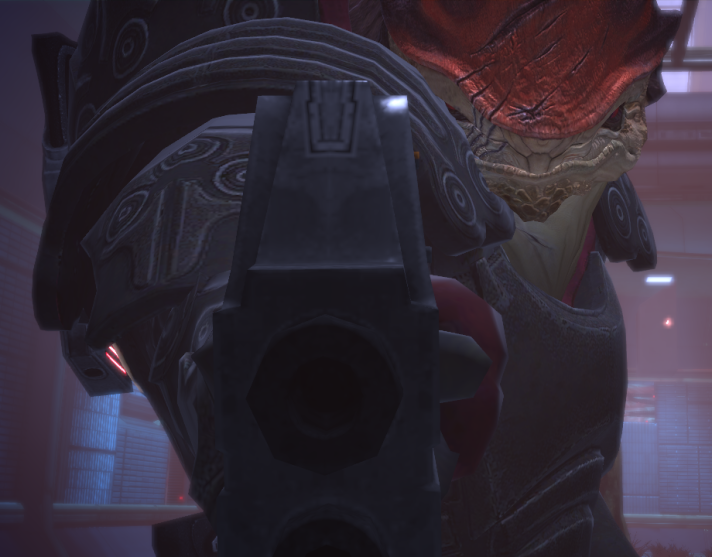
 But of course my favorite NPC was the krogan Battlemaster, Urdnot Wrex. The ancient, battle-scarred warrior is every bit as badass as he looks. His gruff exterior hides that he's genuinely worried about the krogan race, which is infected with a virus that has cut their fertility rate so badly that they're all dying out. It doesn't help that he often finds himself going up against other krogans, further lowering the numbers of his already endangered race.
I'll try not to say too much about the NPCs, because getting to know them is one of the coolest things about the game.
The main plot is suitably epic, and really hits the ground running. You don't waste any time killing rats and beetles in Mass Effect. The first enemies you fight are the minions of the main bad guy, Saren.
.png) Saren is a Spectre, an agent of the Citadel Council who has special permissions to operate outside the bounds of ordinary justice. His motivations are mysterious, but his main goal is no big shocker: he wants to wipe out all life in the universe. And guess who gets to stop him?
Saren is a Spectre, an agent of the Citadel Council who has special permissions to operate outside the bounds of ordinary justice. His motivations are mysterious, but his main goal is no big shocker: he wants to wipe out all life in the universe. And guess who gets to stop him?
As the player, you take the role of Commander Shepard. You can choose a first name for Shepard when you create the character, but everyone just refers to you as Commander and/or Shepard. You can choose to play as a male or female Shepard, and you also choose his or her appearance. I played as a male Shepard, so I'll refer to Shepard as "he." You also choose a role for Shepard, who can focus on firepower, technological attacks, or biotic powers (think of biotics as Mass Effect's version of the Force). You may choose to focus on two of these areas instead of just one, so I took a firepower/technological blend.
Your other choice with Shepard is to go either Paragon, Renegade, or a mixture of both. Unlike the normal good/bad choices that most RPGs offer, in which you can choose to either lie, steal, and kill your way through the plot or to stop and save every lost child and sick puppy you come across, Mass Effect gives you two ways to achieve the same goals: you can either go in guns blazing as a Renegade, sometimes sacrificing civilians to get the job done, or you can take the more careful approach of the Paragon, going out of your way to make sure only the bad guys get hurt. I appreciated that the game doesn't try to trick you about which choices are Paragon and which are Renegade.
To me, one of the best moments in Mass Effect was when I had the ability to choose, about halfway through a game, to either kill an NPC or allow it to live. I won't say any more, but even though I was playing a Paragon, I had a very hard time convincing myself to make the Paragon choice. It's when a game can make you pause and grapple with a decision that you know you're playing something golden.
That's not to say that the Paragon/Renegade system always works perfectly. A lot of times, the only difference between a Paragon and a Renegade is that the Paragon avoids civilian casualties, while the Renegade does not. This can be as simple as avoiding having civilians wander into the crossfire in a gunfight.
Soon after Shepard starts chasing after Saren, the Citadel Council makes him the first human Spectre. This allows you to choose your team and fly off in your new spaceship, the Normandy. Even though the Normandy's only purpose in the game is to ferry you from one quest to the next, I loved being able to run around inside my ship between missions, talking to NPCs and party members, and exploring my ship (which just happens to be the best ship in the human fleet).
After playing some Fallout 3, it felt great to play a game where I did not have to worry about stocking up on ammo or repairing my gear. In Mass Effect, all weapons have unlimited ammo, but overheat if you fire too quickly. Also, weapons and armor do not degrade and never have to be repaired
One thing I could have done without, though, was the unnecessarily complicated inventory system (which I hear has been improved in the sequel). All weapons have many levels. The only thing this accomplishes is to ensure the you routinely need to switch out your weapon for another weapon of the same model but a better level. You also have to stick in upgrades to your weapons and armor, giving you extra damage or effects. Like the weapons, the individual upgrades also have levels, so you'll be switching them out throughout the game.
Another time-consuming aspect of the game is the amount of time you spend getting from place to place. This was my biggest gripe about the game. Almost every planet you land on is extremely mountainous, and you drive your all-terrain vehicle, known as the Mako, over endless hills and mountains to get from where you landed to where your mission is. This might not be so bad if there was more scenery along the way, but for the most part you don't even get trees or lakes to drive past.
Worse, if you come across some bad guys, you'll probably want to jump out and kill them on foot, because using the Mako's powerful guns to kill bad guys yields significantly fewer experience points than killing them on foot. This leads to the immersion-breaking realization that you can whittle down a big opponent's hit points with the Mako's guns, then jump out and finish it off with your regular weapons for the larger share of experience points.
The only point to driving from your landing point to your mission is that you sometimes come across a deposit of ore or a crashed probe or something. These do one of two things: give you items and experience, or give you money and experience. Helpful, but not worth boring, bumping driving to get to.
Whenever you interface with a rock deposit, crashed probe, beacon, locked box, or encrypted computer, you'll play a mini-game I think of as "circular Frogger." It's pretty intuitive and easy to get good at, and as far as hacking/lockpicking mini-games go, I actually quite liked it.
I'm sure I've left out some other things I should say, but this review is long enough now. I hope that those of you who haven't already played this excellent game will check it out. I, for one, have started a second play-through, this time as a female Shepard who will be going Renegade. I also look forward to importing my first Shepard into Mass Effect 2 as soon as I buy it. And Mass Effect 3 is coming out soon, too!
So, I'll end with this:
...Wrex.
...Shepard.

Mass Effect is set in its own universe, and the writers did a marvelous job filling out this world and making it every bit as immersive as the Star Wars and Dungeons and Dragons properties that Bioware has worked with in the past. The game includes an in-game Codex that fills up as you play with interesting facts about the planets, races, monsters, factions, and technology you come across.
If I had to pick a favorite thing about Mass Effect, it would be the NPCs. As much as I loved seeing the cool settings and playing through the interesting and thought-provoking missions, hanging out with some of the coolest characters I've ever seen in a video game definitely made every part of the game even better.


I have to confess I developed quite a crush onTali'Zora nar Rayya, the quarian mechanic on a pilgrimage to find things to bring back to her people's fleet of aging starships.
I'll try not to say too much about the NPCs, because getting to know them is one of the coolest things about the game.
The main plot is suitably epic, and really hits the ground running. You don't waste any time killing rats and beetles in Mass Effect. The first enemies you fight are the minions of the main bad guy, Saren.
.png)
As the player, you take the role of Commander Shepard. You can choose a first name for Shepard when you create the character, but everyone just refers to you as Commander and/or Shepard. You can choose to play as a male or female Shepard, and you also choose his or her appearance. I played as a male Shepard, so I'll refer to Shepard as "he." You also choose a role for Shepard, who can focus on firepower, technological attacks, or biotic powers (think of biotics as Mass Effect's version of the Force). You may choose to focus on two of these areas instead of just one, so I took a firepower/technological blend.
Your other choice with Shepard is to go either Paragon, Renegade, or a mixture of both. Unlike the normal good/bad choices that most RPGs offer, in which you can choose to either lie, steal, and kill your way through the plot or to stop and save every lost child and sick puppy you come across, Mass Effect gives you two ways to achieve the same goals: you can either go in guns blazing as a Renegade, sometimes sacrificing civilians to get the job done, or you can take the more careful approach of the Paragon, going out of your way to make sure only the bad guys get hurt. I appreciated that the game doesn't try to trick you about which choices are Paragon and which are Renegade.
To me, one of the best moments in Mass Effect was when I had the ability to choose, about halfway through a game, to either kill an NPC or allow it to live. I won't say any more, but even though I was playing a Paragon, I had a very hard time convincing myself to make the Paragon choice. It's when a game can make you pause and grapple with a decision that you know you're playing something golden.
That's not to say that the Paragon/Renegade system always works perfectly. A lot of times, the only difference between a Paragon and a Renegade is that the Paragon avoids civilian casualties, while the Renegade does not. This can be as simple as avoiding having civilians wander into the crossfire in a gunfight.
Soon after Shepard starts chasing after Saren, the Citadel Council makes him the first human Spectre. This allows you to choose your team and fly off in your new spaceship, the Normandy. Even though the Normandy's only purpose in the game is to ferry you from one quest to the next, I loved being able to run around inside my ship between missions, talking to NPCs and party members, and exploring my ship (which just happens to be the best ship in the human fleet).
After playing some Fallout 3, it felt great to play a game where I did not have to worry about stocking up on ammo or repairing my gear. In Mass Effect, all weapons have unlimited ammo, but overheat if you fire too quickly. Also, weapons and armor do not degrade and never have to be repaired
One thing I could have done without, though, was the unnecessarily complicated inventory system (which I hear has been improved in the sequel). All weapons have many levels. The only thing this accomplishes is to ensure the you routinely need to switch out your weapon for another weapon of the same model but a better level. You also have to stick in upgrades to your weapons and armor, giving you extra damage or effects. Like the weapons, the individual upgrades also have levels, so you'll be switching them out throughout the game.
Another time-consuming aspect of the game is the amount of time you spend getting from place to place. This was my biggest gripe about the game. Almost every planet you land on is extremely mountainous, and you drive your all-terrain vehicle, known as the Mako, over endless hills and mountains to get from where you landed to where your mission is. This might not be so bad if there was more scenery along the way, but for the most part you don't even get trees or lakes to drive past.
Worse, if you come across some bad guys, you'll probably want to jump out and kill them on foot, because using the Mako's powerful guns to kill bad guys yields significantly fewer experience points than killing them on foot. This leads to the immersion-breaking realization that you can whittle down a big opponent's hit points with the Mako's guns, then jump out and finish it off with your regular weapons for the larger share of experience points.
The only point to driving from your landing point to your mission is that you sometimes come across a deposit of ore or a crashed probe or something. These do one of two things: give you items and experience, or give you money and experience. Helpful, but not worth boring, bumping driving to get to.
Whenever you interface with a rock deposit, crashed probe, beacon, locked box, or encrypted computer, you'll play a mini-game I think of as "circular Frogger." It's pretty intuitive and easy to get good at, and as far as hacking/lockpicking mini-games go, I actually quite liked it.
I'm sure I've left out some other things I should say, but this review is long enough now. I hope that those of you who haven't already played this excellent game will check it out. I, for one, have started a second play-through, this time as a female Shepard who will be going Renegade. I also look forward to importing my first Shepard into Mass Effect 2 as soon as I buy it. And Mass Effect 3 is coming out soon, too!
So, I'll end with this:
...Wrex.
...Shepard.
Wednesday, September 15, 2010
What if you leveled up?
I was talking to my friend Kage about this, but I found it so fascinating that I decided to share it with the two other people who also read my blog. What if you were given points to distribute among your attributes, skills, and abilities?
I think this makes a fascinating question to ponder.
Would you improve on your strengths, maximizing your ability to do the things you already do well? This would probably move you toward fame and fortune, since chances are that your current occupation and interests use your strongest abilities.
Or would you take the opportunity to improve on some areas where you are currently lacking? In the long run, this might make you happier, as it gives you the opportunity to shore up the weaknesses that make you suffer.
Or you could put your points into something not practical at all. Maybe it's time you improved your ability to speak with cats. You could start working on your ability to breathe underwater, or open up a new multiclass in Telepath or Pyrokineticist.
In this scenario, you can improve anything, and it's up to you how to distribute your level up. You could dump it all into one stat, raising that one thing a lot while leaving everything else the same, or you could improve a number of things to a lesser degree.
Consider: what are some things about yourself that you would like to improve? This is your chance to get something you've been meaning to work on but haven't gotten to it. Want to work off some of that gut? Improve your DEX. Been meaning to go jogging to work on your cardio? Bump up your CON. Or if your significant other complains that your cooking is terrible, throw out the cookbook and dump all your points in Cooking. You can get all the improvement with none of the hard work!
Alternatively, when you consider that anything can potentially be improved, you could add to things that you could never get better at. Want to be taller? Improve your Height stat. Want to get rid of your glasses? Improve your Spot skill. After all, why would you improve something that you could work on anyway, when you can improve something you otherwise wouldn't be able to?
Personally, I'd probably dump everything* into Perception. I tend to be somewhat oblivious sometimes (sorry, dear), and I would love to be more aware of what's going on around me.
What about you?
* Well, maybe I'd save a point or two for the Chainsaw skill so that I can eventually qualify for Chainsaw Monk.
I think this makes a fascinating question to ponder.
Would you improve on your strengths, maximizing your ability to do the things you already do well? This would probably move you toward fame and fortune, since chances are that your current occupation and interests use your strongest abilities.
Or would you take the opportunity to improve on some areas where you are currently lacking? In the long run, this might make you happier, as it gives you the opportunity to shore up the weaknesses that make you suffer.
Or you could put your points into something not practical at all. Maybe it's time you improved your ability to speak with cats. You could start working on your ability to breathe underwater, or open up a new multiclass in Telepath or Pyrokineticist.
In this scenario, you can improve anything, and it's up to you how to distribute your level up. You could dump it all into one stat, raising that one thing a lot while leaving everything else the same, or you could improve a number of things to a lesser degree.
Consider: what are some things about yourself that you would like to improve? This is your chance to get something you've been meaning to work on but haven't gotten to it. Want to work off some of that gut? Improve your DEX. Been meaning to go jogging to work on your cardio? Bump up your CON. Or if your significant other complains that your cooking is terrible, throw out the cookbook and dump all your points in Cooking. You can get all the improvement with none of the hard work!
Alternatively, when you consider that anything can potentially be improved, you could add to things that you could never get better at. Want to be taller? Improve your Height stat. Want to get rid of your glasses? Improve your Spot skill. After all, why would you improve something that you could work on anyway, when you can improve something you otherwise wouldn't be able to?
Personally, I'd probably dump everything* into Perception. I tend to be somewhat oblivious sometimes (sorry, dear), and I would love to be more aware of what's going on around me.
What about you?
* Well, maybe I'd save a point or two for the Chainsaw skill so that I can eventually qualify for Chainsaw Monk.
Subscribe to:
Posts (Atom)